‘Frighteningly easy’: How fake AI payslips fuel mortgage fraud (The view of an experienced MLRO)24/8/2026  Viewpoint: The Arms Race in Home Loan Verification - By a Chief Money Laundering Reporting Officer (MLRO) with 15 Years in Australian Big Four Banking Compliance This opinion piece is written in response to an article appearing in the Sydney Morning Herald* When I joined the compliance team at a major Australian bank 15 years ago, mortgage fraud was a relatively analogue affair. Detecting forged payslips usually meant looking for mismatched fonts, sloppy alignment in converted PDFs, or tax calculations that didn't quite add up. Today, generative AI has completely dismantled those basic safeguards. The latest report from The Sydney Morning Herald—highlighting how fake AI-generated payslips are fueling home loan fraud—matches what those of us on the front lines have been warning about for months.  Brendan Thomas, AUSTRAC CEO Brendan Thomas, AUSTRAC CEO AUSTRAC CEO Brendan Thomas and Australia chief financial crime fighter said the findings of its Fintel Alliance exposed vulnerabilities across the lending sector that could not be addressed by individual institutions acting alone. Mr Thomas said: “The scale of this activity should be a wake-up call for every lender. The same warning signs were found across banks that together cover the vast majority of Australia's mortgage market...While this project did not identify evidence of widespread money laundering, the weaknesses it exposed could be exploited by criminals seeking to abuse Australia's financial system.” What we are witnessing is not just a rise in opportunistic borrowers inflating their incomes to beat housing affordability pressures; it is a fundamental shift in operational risk and systemic AML/CTF (Anti-Money Laundering and Counter-Terrorism Financing) exposure. Traditional Forgery v AI-Generated Forgery 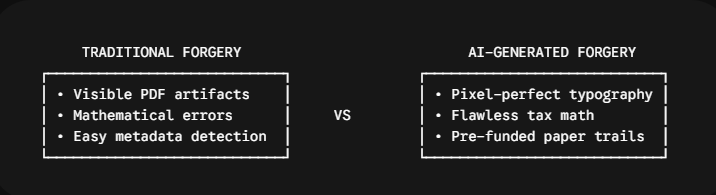
1. The Quality Gap Has Closed In the past, catching document fraud relied heavily on visual triage and automated scanning software flagging document metadata. AI tools have rendered those controls largely obsolete. Generative models don't make rounding errors on PAYG tax withholdings, nor do they leave awkward white boxes around modified text. They generate pristine, mathematically coherent documents from scratch. More concerning is how these documents are operationalized. Organized syndicates aren't just sending in a single synthetic document. They are creating coordinated paper trails—linking AI-generated payslips to real transaction histories in bank accounts that have been pre-funded to simulate regular payroll deposits over months. 2. The Shift from Credit Risk to Money Laundering From an MLRO perspective, mortgage fraud is rarely just about a customer trying to borrow an extra $100,000. Under Australian law, a property purchased with the proceeds of crime—or acquired through a loan obtained by deceptive means—represents money laundering. When rogue brokers or criminal networks facilitate fabricated applications at scale:
3. Moving Past Document Inspection If this trend proves anything, it is that document verification is dead. Relying on a customer or broker to upload a PDF as proof of income is no longer a viable primary control. To protect the financial system, Australian banks must accelerate two major transitions: Image: Current State v Required State 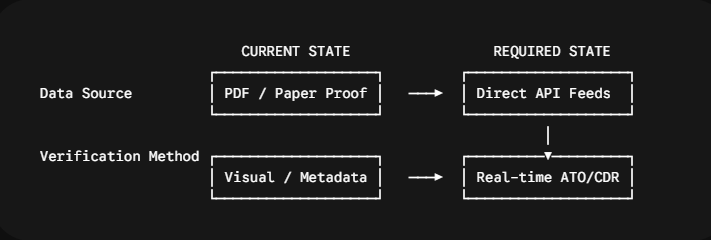
The Road Ahead Generative AI has democratized financial forgery. For financial crime teams across Australia's major banks, the response cannot be incremental. To safeguard the housing market and maintain the integrity of our financial system, the industry must move beyond document-based trust and establish automated, authoritative verification across every loan pipeline.
0 Comments
|
AuthorNews/Typologies appearing here are curated and/or created by Peter Oakes a leading global governance and risk expert. If you would like to contribute get in touch here Archives
August 2026
Categories
All
|

 RSS Feed