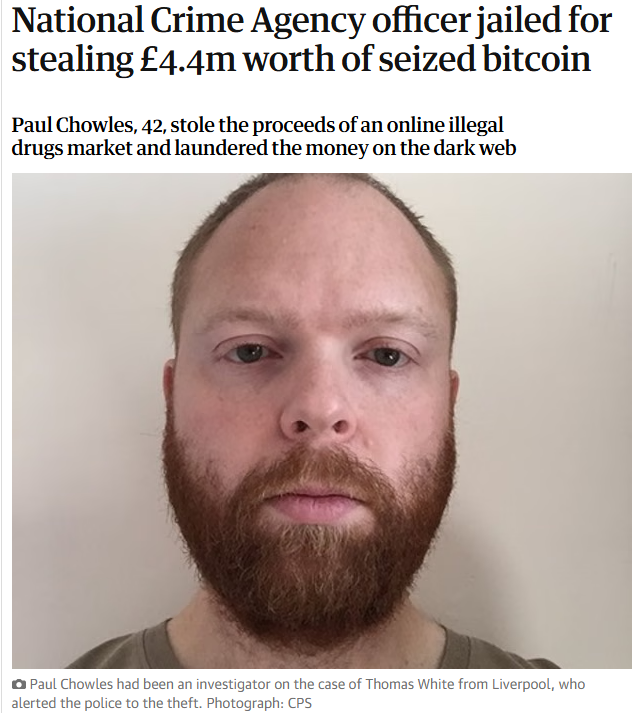
 Paul Chowles, 42, stole the proceeds of an online illegal drugs market and laundered the money on the dark web Definitely a great AML typology for MLROs' training kit and of course a useful Know Your Employee one as well. I would love to hear from current law enforcement officers and the many ex law enforcement officers in the network on their thoughts on this case. A National Crime Agency (NCA) officer has been jailed for stealing £4.4m worth of bitcoin seized during a joint operation with the US Federal Bureau of Investigation (FBI), after the criminal he was investigating told the police it was missing. Paul Chowles thought he had got away with the crime for five years, prosecutors said, after laundering the money on the dark web and spending £613,000, mostly on day-to-day expenses. The 42-year-old had been working as an investigator on the case of Thomas White from Liverpool, who ran an online black market for illegal drugs, known as Silk Road 2.0, launched a month after a website of the same name was shut down in 2013 by the FBI. It was White, while under investigation, who noticed someone had taken 50 bitcoin of the 97 he had, and told police it had to be someone inside the NCA because they had the private keys for his cryptocurrency wallet. Merseyside police, which had responsibility for managing White in the local area following his release on licence in early 2022, discussed the theft with the NCA, in meetings that Chowles attended. During the investigation, officers discovered Chowles had stolen the money between 6 and 7 May 2017, two years after the White investigation was over, and in the following five years had been spending it in supermarkets and hardware stores and on fuel and meals, with investigators uncovering hundreds of debit card transactions. What are some of the lessons from this case? Generally, the case of the NCA officer jailed for stealing seized bitcoin offers sobering lessons for Money Laundering Reporting Officers (MLROs) and law enforcement agencies. It underscores the critical threat posed by insider abuse and the importance of knowing your employees—especially those entrusted with sensitive financial or digital assets. More specifically, here are 5 Key Lessons for MLROs and Law Enforcement. Key Lessons for MLROs and Law Enforcement 1. Insider Threats Are Real and Costly Even trusted officers can exploit access for personal gain. Chowles used his position to divert seized Bitcoin, bypassing internal controls. Insider threats are harder to detect than external ones because they exploit legitimate access. 2. Know Your Employee (KYE) Is as Crucial as KYC Background checks, ongoing vetting, and behavioral monitoring are essential. Chowles had no prior criminal record, but his misuse of crypto tools went unnoticed for years. Agencies must implement continuous risk assessments for staff in sensitive roles. 3. Weak Internal Controls Enable Exploitation Chowles used mixing services to obscure transactions—a red flag for MLROs. Lack of multi-signature wallets, audit trails, and real-time monitoring allowed the theft to go undetected. Agencies must adopt blockchain analytics tools and segregation of duties. 4. Training in Crypto Forensics Is Vital Law enforcement and MLROs must understand crypto mechanics, including wallets, mixers, and blockchain tracing. Chowles exploited gaps in institutional knowledge to cover his tracks. Regular training and collaboration with tech experts can close these gaps. 5. Reputation and Public Trust Are at Stake This case damages the credibility of the NCA and raises doubts about asset integrity. MLROs must ensure that seized assets are handled transparently and securely. Agencies should publish audit results and enforce accountability to rebuild trust. What are some of the strategic takeaways from this case? 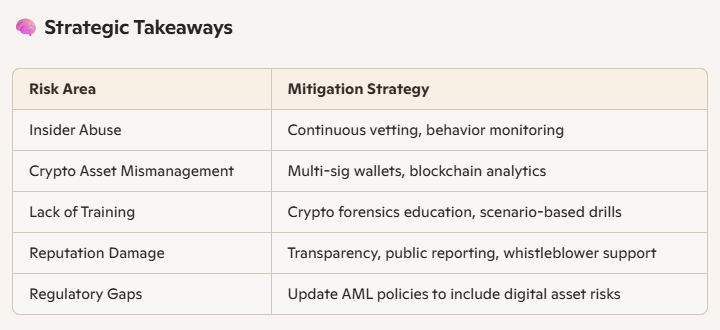 Sources:
0 Comments
 Real estate agents, lawyers and accountants used to launder the money of drug dealers and terrorist-funders will be the target of new laws to stop the flow of dirty money in Australia.
Attorney-General Mark Dreyfus has announced strict reporting obligations for about 100,000 new entities. The move, which will include $165 million in new funding, has been resisted for years by real estate associations and other professional services lobby groups, who argue it would be costly and risk client confidentiality. Only casinos, bullion dealers and some solicitors are now required to report suspicious transactions of more than $10,000, making Australia one of only five countries whose rules do not extend to lower-level risks such as real estate agents. “Let me be very clear: opposing these reforms means aiding and abetting the criminal abuse of our financial system by drug traffickers, people smugglers, terrorists and those who exploit and abuse children,” Dreyfus will say in a National Press Club speech, according to speaking notes. Britain has also urged Australia to beef up its laws because international criminals exploited the weakest links in global regimes. Source: https://www.smh.com.au/politics/federal/real-estate-agents-lawyers-in-spotlight-for-money-laundering-crackdown-20240708-p5jrzn.html See also: Lawyers among opposers of new money laundering laws |
AuthorNews/Typologies appearing here are curated and/or created by Peter Oakes a leading global governance and risk expert. If you would like to contribute get in touch here Archives
August 2026
Categories
All
|
 RSS Feed